Showing posts with label Weekly Torah Portion. Show all posts

Thursday, August 8, 2013

This World, The Next World, and Your Socks

The end was drawing near. Mr Wolf Lazerson, one of the richest Jews in the country was on his death bed with all his children surrounding him. "I have two last requests to make," he said in a weak voice. "The first is that you do not read my will until the shloshim, and the second is that you bury me with my socks on"

"But Dad," his son protested "halacha doesn't  allow such a thing."
"I don't care," Wolf said "that's what I want." No amount of convincing was going to change his mind. He insisted on keeping the socks on, and that was that. His children were disturbed knowing that their father insisted on doing something that he himself knew was contrary to halacha.

A few days later, the father was niftar and the children consulted a poseik who told them that their father's wish must be ignored and so he was buried without his socks. At the shloshim, they opened his will. "My dear Children," they read, "I left you a lot of money and a large estate. I wanted you to realize before dividing it up that in the end you can't take any of it with you - not even your socks. love, Dad."

and as Rabbi Dovid Kaplan concluded, a story like this can really knock your socks off.

In this weeks sedra, it says "VeLo takim lecha matzeva asher saneh Hashem Elokecha" 
"and you shall not make for yourselves a pillar..."
It is brought down in Pirkei Avot, this world is compared to a corridor leading up to the world to come. Fix yourselves in the corridor so you can enter the Banquet Hall. A person needs to be constantly aware that this world is fleeting and temporal. One must utilize all his worldly dealings and all his physical necessities as a preparation for the service of G-d, for the world to come.  Chazal often refer to "worldly pleasures" as "lecha" (literally "for yourselves")

Kedushas HaLevi teaches us that the Torah is saying "VeLo takim lecha matzeva..." and you shall not make the "Lecha" a pillar.  In other words, you shall not make your worldly pleasures into a pillar, i.e., into that which is strong, sturdy and everlasting, but rather, only as preparation for the world to come.

May we  merit to utilize all that Hashem gives us leTova.

Credit:
The short story at the top was taken from Rabbi Dovid Kaplan's Lasting Impact - Short Stories with an Immediate Message - Awesome for the Shabbos Table!


Thursday, December 17, 2009

Parshat Miketz 5770 2009 - Loving Your Fellow jew

Parshat Miketz tells of the sons of Yaakov traveling to Egypt to buy food and bring it back to their father. Yosef tries to foil their plans by accusing his brothers of being spies because their father wouldn't have to send all 10 sons to get food, and the brothers respond that "we are all sons of one man" (42:11). How does that explain why they were all sent? The suspicion Yosef raises still exists!?

In Majesty of Man, Rabbi Leibowitz explains that when Hillel and Rabbi Akiva emphasized loving our fellow man as ourselves, they were describing fundamental principles of the Torah. As the Ramban explains, although the trip to Egypt was long and dangerous, Yaakov felt that developing the brothers' feeling of unity and brotherhood was worth the risk. This Ahavat Yisrael (love for a fellow Jew) is so critically important that Hillel and Rabbi Akiva stressed it, and Yaakov risked his own sons' safety for it. If we neglect each other's needs in the outside world, in the workplace and at home, we're placing ourselves in danger of losing the comm"unity" we strive to be a part of.

Dvar Torah Provided by: Jeff Siedel | WorldWideJewish Network on FB

Thursday, November 12, 2009

Dvar Torah Parshat Chaye Sarah 5770 2009

Parshat Chaye Sarah records two major transactions, which begs us to wonder about their connection. The Parsha starts with Avraham insisting on paying for his plot of land in which to bury his wife. After much negotiating, Efron agrees to accept payment for the plot. The Parsha then goes into even greater detail describing the efforts of Avraham's servant in finding a suitable wife for Yitzchak, his son. What's the connection, other than then technically both being "transactions"?
One possibility is that the dialog of the first transaction could be the requisite to the completion of the second! In other words, Avraham had to understand and negotiate a FAIR transaction where both sides benefit before he could find a wife for his son. This requirement says a lot about what it takes to find a suitable mate: Give! If you find yourself taking more than you're giving in a given relationship, you need to insist on adjusting it! If any marriage is to work, the first ingredient is mutual respect, which breeds mutual giving. It is this fact that Avraham mastered before venturing to find his son a wife, and it's this lesson that we should master before venturing to find our own mates.
This Dvar Torah was provided by:Jeff Sidel

Thursday, November 5, 2009

3 Angels for 4 Tasks - Dvar Torah Parshat Vayera 5770 2009


QUESTION: 3 angels came down to the world: Raphael Michael, and Gavriel. But there were 4 missions to accomplish.
1.To Heal Avaraham
2.To Save Lot
3.Tell Sarah the news about her having a son
4.To Destroy Sdom.
Why didn't Hashem send 4 angels to do this?


ANSWER: I have to begin with a fascinating story told of Rav Shlomo Kluger - There was once a family who wanted to postpone the circumcision of their son in order to name the child after a relative who was deathly ill, and who was about to pass away at any given moment. Rav Kluger told the family to go ahead with the Bris, and not to wait any longer. The family followed the Rav's advice and they went ahead with the Bris. The deathly ill relative ended up not dieing. He actually went on to continue living a happy and healthy life.
The Rav explained how he learned this from Parshat Vayera and the Angel of Avraham and Lot.

Which will also answer our question:
Lot did not have enough merits (zechuyot) to bring an Angel down to this world to save him. But since Hashem was already sending down an Angel to heal Avraham after the Bris Mila, Lot was able to be saved once that Angel was already here.


It is known from our tradition that Eliyahu Hanavi comes down and attends the Bris of every Jewish boy. The deathly ill relative did not have enough merits to bring down an Angel to heal him. Although as soon as the family made a Bris Mila for their son - since Eliyahu Hanavi was already down in this world, the deathly ill relative was able to be healed by him.

Shabbat Shalom..

Wednesday, October 28, 2009

Lech Lecha 5770 / 2009 - Becoming an Abraham

In Parshat Lech Lecha, among the blessings that Avraham was to receive for leaving all that he had was the blessing that he himself should be a blessing (12:2). How does one become a blessing? Furthermore, Rashi comments that G-d promised Avraham that although he would be identified with Yitzchak and Yakov, any such blessings would end with Avraham's name at its conclusion. If the sages are correct that Yitzchak and Yakov reached higher levels than Avraham, what made him so special that any blessing would end with him?

Rav Moshe Feinstein explains that Avraham merited greater distinction because he was the first to establish faith in Hashem (G-d). Although those after him reached greater heights, Avraham's accomplishments were more worthy. Maybe this can explain how Avraham himself became the blessing: Taking initiative and starting something you believe is important for society is a blessing on its own, because it lays the framework for others to build on it! G-d promised Avraham, and in turn promised us, that, if we become leaders and initiators, our initial efforts will never be forgotten and we will always be remembered as a blessing!

This Dvar Torah was provided by:
The Jewish Worldwide Network

Friday, October 23, 2009

Results that we don't see...

I recently heard an amazing and inspiring lecture from Reb Tzvi Meir Zilberberg.
What an experience! You had to be there.
So here is something I picked up from the shmooze - maybe it will inspire you too.

Hashem told Noach to build an ark since a flood is coming.
Hashem didnt Say when.
Noach kept on building.
He kept building... for 120 years no flood came....
He kept on building even without seeing any results.
He served Hashem with "Temimut" (Simpleness?)

Hashem told him to get the people to do Teshuva.
....Noach tried.
Noach was unsuccesful in geting anyone to do Teshuva....
But he kept on trying and trying.
In the end, Noach bacame a zookeeper...looking after animals.
Not exactly what he had in mind...yet
He kept on serving Hashem.
Noach is the only one in the TORAH 5 books who is termed a "TZADIK".
anyways, our Sagesl teach us that The Big Teshuva Movement that will sprout up in the End of Days before Moshiach arrives..will be b'zechut these efforts of Noach (in other words in his merit)

Similar to Rabbi Akiva who saw the water dripping on a rock and noticed how that constant dripping over time had created a hole in the rock.
Could one drop of water create a hole in a rock?
Not each one individually ... but...one drop... one drop... one drop...and another drop...etc etc
All together they are creating the hole.

We dont see the results of our actions, we do one good action here and another...we may see NO RESULTS.... but they are impacting the whole world more then we can imagine...and the results will be seen, B"H sooner than later!

Have a good Shabbos
Aaron

Thursday, September 17, 2009

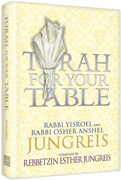
BOOK REVIEW: TORAH FOR YOUR TABLE - A personalized guide to the essence of the Torah


BY: RABBI YISROEL JUNGREIS and RABBI OSHER ANSHEL JUNGREIS
Compiled By: Rebbetzin Esther Jungreis

Book Review by: Guest Contributor, Fern Sidman
There is no doubt that the times that we live in are fraught with innumerable dangers. For the Jewish people, it is a particularly horrifying juncture in the annals of our history, as we witness an exponential rise in anti-Semitism and the continued demonization of Israel; while the world remains eerily silent. On a collective scale, our nation is faced with the escalating and alarming scourge of intermarriage, assimilation and youth alienation. Our personal lives have taken on an ever increasing load of financial challenges and emotional stresses that often result in families being torn asunder. From time immemorial, the indefatigable Jew has faced similar, if not infinitely worse scenarios in terms of our personal and national survival, yet has continued to prevail over all pernicious forms of adversity. The question has often been asked, "Given their history, how could the Jewish nation possibly survive and even triumph?"

In order to keep us afloat and exhilarated for the upcoming new year, Artscroll Publications has released an exceptionally enlightening and incredibly inspiring compendium of Torah insights, entitled "Torah For Your Table", penned by brothers, Rabbi Yisroel and Osher Anshel Jungreis. If the surname of the writers sound at all familiar, these Rabbis are the sons of the internationally renowned Torah luminary, Rebbetzin Esther Jungreis, and it is she who has masterfully compiled all of her sons' Torah lectures into this impressive volume for use at home, school or synagogue. The authors have most befittingly dedicated this monumental work of intellectual and spiritual gravitas to their beloved father and mentor, the esteemed Torah scholar, Rabbi Meshulum HaLevi Jungreis, ZT"L.

It is in these pages of "Torah For Your Table" that the brothers Jungreis make it abundantly clear that the key to our survival as Jews can only be found in our unbreakable bond with our G-d and our consistent devotion to His Torah. History has proven that it was the stubborn insistence on the part of the Jew to study Torah, despite the punishments inflicted upon them by their tormentors, that served as our eternal life raft in the tumultuous waters of time. The authors tell us that the legacy of the Jewish people is inextricably tied to our ultimate blessing; our acceptance of the Torah at Sinai. Thus, Hashem has bequeathed to us a precious "road map" called the Torah, in order that we may successfully navigate the often uneven terrain of everyday life and in His munificence, has provided us with the exclusive source of our cherished and unique value system.

Our sojourn through the weekly Torah portions; from Bereishis through Devarim (Genesis to Deuteronomy) is brilliantly enhanced by the profoundly personal, highly original and erudite interpretations of both authors; while their cogent concepts remain traditionally predicated upon the teachings of our commentators and sages of blessed memory. Teaching Torah as it applies to each of us as individuals is no small task, but Rabbi Yisroel and Rabbi Osher speak to our hearts and souls by prodigously paving the path to a comprehensive understanding for students from all backgrounds and all levels of observance. It is apparent that the flames of Torah burn bright in this classic tome, as the passion, warmth and love that the authors have infused here can only be termed palpable..

This refreshingly honest book does not aim to sugarcoat Torah precepts that the world at large may find "politically incorrect" but rather offers a sagacious perspective on the salient and nuanced points in each parsha and how they personally relate to our lives. Citing a plethora of Midrashic and Talmudic sources, the subject matter covered here includes the veritable gamut of Torah related concepts such as the power of prayer, performing chesed, the establishment of a Torah true home, respecting our parents and teachers, designating time for regular Torah study, sensitizing ourselves to the needs of others and the critical importance of remaining ever vigilant concerning our conduct and speech, among hundreds of other timeless concepts.

Reminding us of the infamous words of King Solomon who said, "Death and life are in the tongue", the authors teach us that through the power of speech we have within our capability to create or destroy. "There are more commandments in the Torah in regard to speech than to any other mitzvah; seventeen negative and fourteen positive mitzvos", the authors teach us, adding the admonition, "Think before you speak and ask yourself, 'Will my words generate light or darkness, love or hatred, blessing or curse?' The choice is yours to make. Use your Divine gift of speech carefully and wisely, in the service of the Almighty."

Concerning the tenet of "Gemilus Chasadim" (acts of loving kindness) we learn that our proclivities for such kindness and largesse can be found in our spiritual DNA, as we are taught about the "Ark Rehab" that Noach endured. Of Noach and his family, the authors teach, "In the Ark they had to care for all the animals that G-d had commanded them to gather; backbreaking labor consumed them day and night. Yet through that labor they learned the meaning of chesed - reaching out with gemilus chasadim - one of the pillars on which G-d built His world."

We are also treated to especially poignant anecdotes about beloved members of the Jungreis family and how their living example of Torah precepts helped shape the character of the authors. They recall with great love, "Our bobbe, Rebbetzin Miriam Jungreis, a'h, was a true embodiment of this trait of chesed. Her life was one of constant giving, and even in her last days, as illness racked her frail body, she continued to organize chesed programs for needy Russian immigrants, explaining that if she could not offer help to others, her life had no meaning."

In our fast paced and harried existence, quality time for genuine communication with our families and friends has become severely limited. It would appear that the only time that we have to communicate is at meal time and the authors urge us to use the time we spend at our dining room tables wisely. Rather than engage in mundane chit chat, it is imperative to use our communication skills to impart Torah values to our spouses, children, extended families, friends and guests. Thus, the title of this book, "Torah For Your Table" is not intended as a stellar guide for exclusive use on Shabbos and Yom Tov but for each and every day of the week. Whether it be Monday morning breakfast, Sunday lunch or Wednesday night dinner, we must start off the new year in the proper manner. Throughout the weeks and months ahead we can savor the feeling of re-birth that fills our hearts on Rosh HaShanah and Yom Kippur by making this invaluable Torah companion a staple item at our tables.

Moreover, this parsha book represents a most significant, historic and vital contribution to the corpus of books on Torah literature and its impact will certainly be felt in this generation and generations to come. No home, school, community center or synagogue library should be without it !! A must read for anyone seeking Torah knowledge !!

ORDER BOOK HERE: http://www.artscroll.com/Products/TYTH.html

Tuesday, September 15, 2009

Rosh Hashana Parsha Short Vort


In the Torah reading of this day we are told about the birth of Yitzhak. We then read about his relationship with his brother Ishmael. His mother Sarah saw the bad influence this association had and she demanded of Avraham to send Ishmael away from the household. Avraham refused. Why did he disagree with his wife? Did he not see the evil influence that Ishmael had on Yitzhak?
Read More@ TorahPortion

Friday, July 10, 2009

Parshat Pinchas 2009 5769 - Essence of Peace

By Rebbetzin Tziporah Heller
In this weeks Torah Parsha, Parshat Pinchas, Pinchas' reward of a "brit shalom", a covenant of peace, teaches us what hating evil and loving good is really all about. For more spiritually inspiring Torah insight classes visit www.naaleh.com.

Friday, July 3, 2009

Dvar Torah Parshat Balak 5769 2009 - A Good Eye

Shira Smiles: A good eyed people, according to the Torah in Parshat Balak, are the disciples of Avraham Avienu. A person can be involved in chesed all day but if they have an evil eye they will not benefit from this and the next world. If chesed comes out of selfishness then it is not true chesed. We must try to be like Avraham Aveinu and do chesed for others completely. For more Torah classes visit www.naaleh.com

Thursday, July 2, 2009

Parshat Chukat 2009 5769 - Power of Prayer

Rebbetzin Tziporah Heller gives a short vort on the Parsha.
In this week's Torah portion, Parshat Chukat, the episode of Moshe and "Mei Meriva" sheds light on the role of Moshe Rabbeinu as our leader and the lessons of prayer he imparted to us. For more inspiring Torah classes visit www.naaleh.com